
Website report
1 October 2026
Prepared for Aden by Tye, ForgedWeb
The new Mould Medico site, measured against the current one.
You wanted to see how the new site actually stacks up. So I tested both live sites the same way, on the same day, with the same tools Google uses. Everything on this page is a measurement, not a guess. Where the current site already does something well, I've said so.
The new site is live on a temporary address while you look it over: forgedweb-mouldmedico.pages.dev. It's hidden from Google until it moves onto mouldmedico.com, so the two sites don't compete in the meantime.
Google speed score on a phone
Seconds until the page shows on a phone
Data a phone has to download
Security grade
The bottom line
More people find you, more of them stay, and more of them ask for a quote.
A website only matters if it brings in work. Here's how the new one does that, from someone typing "mould removal" into Google to Stephen's phone ringing. Every number below is measured on the two live sites.
-
1. Found on Google
Built for the way Google ranks pages
Every one of your 60 pages keeps its address, so the rankings you've already built aren't thrown away. On top of that, the new site fixes what Google looks at: speed, page titles and descriptions (31 of 60 right now, 60 of 60 new), and the hidden labels that tell Google what each page is about (service pages 2 to 21, FAQ pages 4 to 23). Each of the 12 suburbs has its own page with its own local copy, so someone searching "mould removal Buderim" lands on a page about Buderim.
-
2. They stay
The page is there before they give up
On a phone, the current site takes 6.6 seconds on average to show its main content, and 7.9 seconds on the home page. The new site takes 2.5. Google's research says people are 32% more likely to leave when a page takes 3 seconds instead of 1, and 90% more likely at 5 seconds. A visitor who leaves never sees the quote button.
-
3. They trust you
Proof at the moment they decide
The 5.0 Google rating, IICRC certification, TGA-tested treatment and six-month warranty sit right under the main button. The site explains why bleach doesn't work, shows where mould hides in a Queenslander, and answers "will it come back?" with the warranty. The psychology section further down explains each of these.
-
4. They ask for a quote
Easier to say yes, and better leads for Stephen
The quote starts with one tap instead of six empty boxes, and asks for 3 typed things instead of 5. And Stephen gets more than a name and a phone number: what the problem is, where, how big, which rooms, the suburb and photos. He can call back ready with an answer instead of starting from scratch.
-
5. Ready to grow
Set up for ads when you want them
If you ever run Google or Facebook ads, they send people to a page and expect a privacy policy when you collect contact details. The new site has one. Google also charges less per click when the page an ad lands on is fast and relevant, and the new pages are both.
What one extra job is worth
Nobody can honestly promise an exact number of extra enquiries before launch. So here's the simple maths instead. Swap in Stephen's real average job value.
| If an average job is worth | 1 extra job a month | 2 extra jobs a month |
|---|---|---|
| $800 | $9,600 a year | $19,200 a year |
| $1,500 | $18,000 a year | $36,000 a year |
| $3,000 | $36,000 a year | $72,000 a year |
An illustration, not a forecast. The point is that a website runs every day for years, so it only has to win a handful of extra jobs to pay for itself many times over.
Side by side
Same business, same words, built new.
All your copy, claims, reviews and contact details carried across. What changed is how it's laid out, how fast it loads, and how it's built underneath.


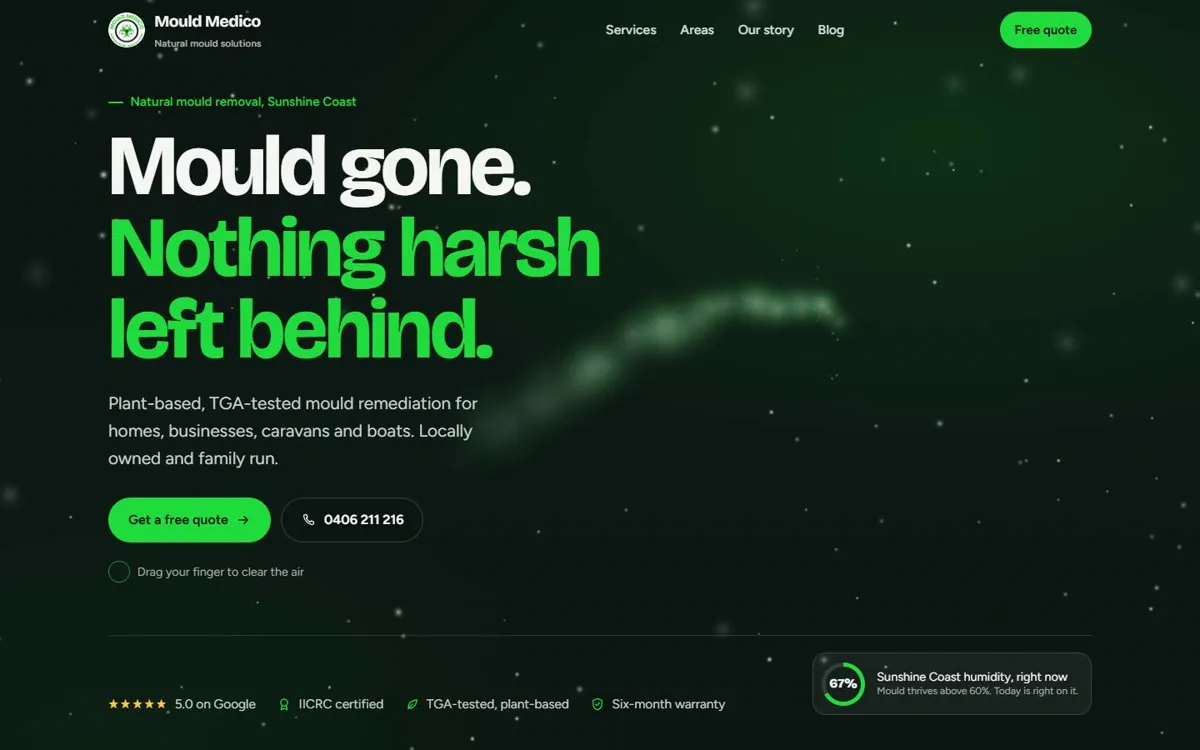
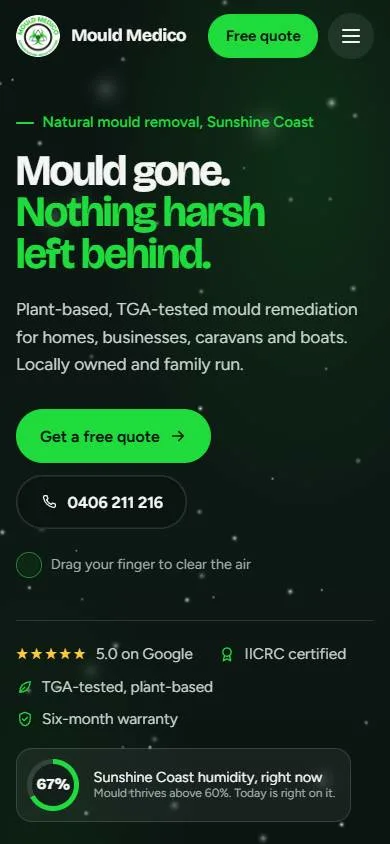
Speed
How long a customer waits on their phone.
Most people find a mould company on their phone, often standing in the room with the problem. Google's own research on mobile pages found that when a page takes 3 seconds instead of 1, people are 32% more likely to give up and leave. At 5 seconds it's 90% more likely. Speed is also one of the things Google uses to rank sites.
| Page, tested as a phone | Speed score | Page shows | Download size | Files | ||||
|---|---|---|---|---|---|---|---|---|
| Current | New | Current | New | Current | New | Current | New | |
| Home page | 64 | 95 | 7.9s | 2.8s | 3.4 MB | 216 KB | 38 | 10 |
| Mould removal (service page) | 65 | 95 | 8.6s | 2.9s | 1.7 MB | 277 KB | 32 | 10 |
| Buderim (area page) | 66 | 98 | 7.0s | 2.3s | 1.1 MB | 159 KB | 31 | 9 |
| Contact / quote | 75 | 83 | 3.9s | 2.1s | 2.0 MB | 144 KB | 57 | 8 |
| Winter mould (article) | 68 | 98 | 5.9s | 2.2s | 878 KB | 155 KB | 27 | 8 |
Green is in Google's "good" range, amber needs work, red is poor. On a laptop with a fast connection the gap is smaller, as you'd expect. Laptop results are further down.
The biggest single problem on the current home page
The home page asks for 5 background images that don't exist. Each time, the server sends back its whole "page not found" page instead, so a phone downloads 1.7 MB of nothing on every visit, out of 3.4 MB in total. It's a leftover from the page builder, and you can't see it, but every customer pays for it in load time and mobile data.
Result sheet, home page on a phone
Read it like a test report.
These are the five things Google measures when it decides whether a page is fast. The reference range is Google's own "good" threshold. Anything outside it is flagged, the same way a lab report flags a high reading.
| What it measures | Current | New | Reference range |
|---|---|---|---|
| First thing appears on screenFirst Contentful Paint | 3.7 s HH | 1.3 s | under 1.8 s |
| Main content is showingLargest Contentful Paint | 7.9 s HH | 2.8 s H | under 2.5 s |
| Page is frozen while it loadsTotal Blocking Time | 0 ms | 0 ms | under 200 ms |
| Things jump around as it loadsCumulative Layout Shift | 0.00 | 0.00 | under 0.10 |
| Data downloaded on a phoneTotal byte weight | 3.4 MB H | 216 KB | under 1.6 MB |
Both sites pass on freezing and jumping around. The difference is all in how long the page takes to show up, and how much it makes a phone download first.
What Google reads
Every page, checked one by one.
I checked all 60 addresses on mouldmedico.com against the same address on the new site. Google ranks pages, not websites, so the details on every page count.
| Check, across all 60 pages | Current | New |
|---|---|---|
| Page titles the right length for Google (30 to 70 characters) | 42 of 60 | 59 of 60 |
| Search descriptions the right length (70 to 160 characters) | 31 of 60 | 60 of 60 |
| Articles marked up as articles for Google | 0 of 33 | 33 of 33 |
| Pages that tell Google which service they cover | 2 | 21 |
| Pages with FAQs Google can read as questions and answers | 4 | 23 |
| Average words on a service page | 155 | 387 |
| Average words on a suburb page | 414 | 528 |
| Average size of the page code (before photos) | 832 KB | 26 KB |
| Addresses that still work | 60 of 60 | 60 of 60 |
Why the addresses matter most
Google already knows your current pages and sends people to them. If a new site changes those addresses, every one of those links breaks and the rankings go with them. So every page on the new site sits at exactly the same address as now, all 33 of your articles and tips came across with it, and anything old WordPress used (like /wp-login.php) redirects to the home page instead of showing an error.
The "marked up for Google" rows are hidden labels in the page code that tell Google exactly what a page is: a service, an article, a list of questions and answers. That's what makes the extra bits show up in search results, like FAQ answers and article dates.
Security and upkeep
Less to look after, and less to break into.
The current site runs on WordPress with a page builder. That's normal and it works, but it means software that needs updating, a login page anyone can find, and a database behind it. The new site is plain files served from Cloudflare's network. There's nothing to log into and nothing to update.
| Independent security grade | Current | New |
|---|---|---|
| securityheaders.comGrades the protections a site asks the browser to apply | F | A+ |
| Mozilla ObservatoryMozilla's own website security test, 12 checks | D 30 points, 8 of 12 passed | A+ 115 points, 12 of 12 passed |
Current site
- WordPress plus 5 plugins and a theme, all of which need regular updates. Out-of-date plugins are the most common way small business sites get hacked.
- The admin login page at
/wp-login.phpis open to anyone on the internet. - 3 account usernames can be read at a public address. I haven't listed them here. A username is half of a login, and this is a default WordPress setting that can be switched off.
- The WordPress version and the speed plugin's version are printed in the page code, which tells automated scanners exactly what to try.
- None of the 6 standard security headers are set.
- No privacy policy or terms page, even though the enquiry form collects names, phone numbers and addresses.
New site
- No WordPress, no plugins, no database. Nothing that needs a monthly update.
- No login page exists, so there's nothing to guess a password on.
- No usernames, version numbers or software names in the page code.
- All 6 standard security headers set. That includes a content security policy, which means only the site's own code can run on it, so a script someone sneaks in gets blocked. Also forced HTTPS, no framing by other sites, and camera, microphone and location turned off.
- Old WordPress addresses like
/wp-login.phpjust redirect to the home page. - A plain-English privacy policy and website terms, written from what the site actually does, linked in every footer.
Other Google scores
Accessibility, best practice and search basics.
Google's test also scores how easy a site is to use for people with poor eyesight or screen readers, whether it follows good practice, and whether it covers the search basics. Out of 100, averaged across the same pages.
| Score, on a phone | Current | New |
|---|---|---|
| Accessibility | 89 | 99 |
| Best practices | 91 | 100 |
| Search basics (SEO) | 98 | 100 |
To be fair to both: the new site's search score leaves out the one check it fails on purpose, being hidden from Google until launch. And the new site loses a few accessibility points for a design choice. On the home page, the big statement fades in word by word as you scroll, and the test reads the words before they've lit up as low contrast.
| Page, tested as a laptop | Current score | New score | Current, page shows | New, page shows |
|---|---|---|---|---|
| Home page | 60 | 98 | 1.2s | 1.1s |
| Mould removal (service page) | 83 | 100 | 0.7s | 0.6s |
| Buderim (area page) | 82 | 100 | 0.9s | 0.6s |
| Contact / quote | 82 | 87 | 0.9s | 0.5s |
| Winter mould (article) | 95 | 100 | 0.8s | 0.5s |
Credit where it's due
What the current site already does well.
- Its search basics were already solid. Every page had a title, a description, a share image and business details Google can read.
- Every image already had a text description.
- It already sits behind Cloudflare, and one of the riskier WordPress doors (
xmlrpc.php) is blocked.
So the new site isn't fixing a broken site. It keeps what was working and fixes speed, structure and upkeep.
The psychology
Built around how people actually decide.
Someone with mould in their house is worried, usually on their phone, and often comparing two or three companies. Looking good isn't enough. The new site is built around a handful of well-known ideas from behavioural research about how people make that kind of decision. Here's where each one shows up, starting with the part that matters most: getting the quote.
| Getting a quote | Current | New |
|---|---|---|
| What you see first | 6 boxes on one screen | One question, "What's going on?", with answers to tap |
| Things you have to type | 5: name, email, phone, job address and a blank job description | 3: suburb, name, and a mobile or an email |
| When it asks for your details | First | Last |
| Shows how far along you are | No | "Question 3 of 9" and a progress bar |
| Responds to your answers | No | Yes, with advice that fits what you picked |
| Leave and come back | Start again | Your answers are still there |
In the quote form
Commitment and consistency
A small yes first
Once people start something, they tend to finish it. So the form opens with an easy tap about the problem, not a request for their phone number. Contact details come last, when they've already put the effort in and want their quote.
Cognitive load
One thing at a time
The more choices on screen, the slower people decide, and the more likely they put it off. Each screen asks one question with a few answers to tap. There's no blank "job description" box to stare at, because the questions do the describing for them.
Goal-gradient effect
Seeing the finish line
People speed up as they get closer to a goal. The form shows "Question 3 of 9" and a progress bar, says "Last thing" on the contact step and "Nearly done. Just press send." at the end. The mould spores floating behind the form also clear as you go, so finishing the quote clears the mould.
Reciprocity
Feeling heard
The form talks back with useful advice before it asks for anything. Say it smells musty but you can't see anything, and it explains the mould is probably hiding in the walls, ceiling or air-con. Mention a baby or asthma and it says the treatment is non-allergenic and safe around babies and pregnant women. Say you have a concession card and it tells you about the discount.
Loss aversion
Effort is never lost
People hate losing work they've done. If someone gets called away halfway through, their answers are still there when they come back, instead of an empty form they'll never fill in again.
Relevance
Questions that fit
The questions change with the answers. A boat or a caravan skips the "which rooms" question, and a business gets offices and storage areas instead of bedrooms and wardrobes. Nobody is asked something that doesn't apply to them.
Across the site
Social proof and authority
Proof right next to the ask
Mould treatment is hard to judge before you've had it done, so people look for proof from other customers and from experts. Right under the main quote button: "5.0 on Google", "IICRC certified", "TGA-tested, plant-based" and "Six-month warranty".
Risk reversal
Taking away the risk
The worry with mould is "will it just come back?". The step-by-step wall ends on the six-month warranty, at exactly the moment that question comes up.
Reframing
Naming the real problem
"Mould is not a cleaning problem. It is a moisture problem, and bleach only makes it harder to see." That explains why their own scrubbing hasn't worked, so calling a professional feels like the logical next step instead of an upsell.
Salience
Here and now
The home page shows the live Sunshine Coast humidity next to "Mould thrives above 60%". A real local number makes the risk feel like theirs, today, instead of a general warning.
Self-discovery
Letting them find it
People believe what they find out for themselves more than what they're told. Tapping around the Queenslander house to find the six places mould hides does that, and it keeps people on the page longer.
Processing fluency
A format everyone trusts
The "What goes into your home" card is laid out like a food nutrition label: 20+ plant actives, 0 bleach, 0 harsh chemicals. A format people already know gets read faster and trusted more than a paragraph making the same claims.
To be straight about it: these are well-established principles, not guarantees, and I haven't measured them on Mould Medico's own customers yet. Once the site is live I can add a simple count of how many people start the quote and how many finish it, so you can see it working with real numbers.
What's included
Everything that's been built.
This isn't a new homepage on top of the old site. It's the whole site, rebuilt properly.
The site
- 63 pages: home, 9 service pages, 12 suburb pages, 33 articles and tips, FAQs, our story, the quote page, privacy and terms
- Every page at the same address as now, with redirects for anything WordPress used, so nothing in Google breaks
- The step-by-step quote form, with smart replies, progress and saved answers
- The interactive parts: the mould you can clear with your mouse or finger, the treatment wall, the Queenslander house, live humidity and the before and after sliders
- Your logo as the preview image whenever someone shares a link
Under the hood
- 266 blocks of Google markup across the site, all checked with zero errors
- A sitemap with every page and image, ready for Google
- A+ security on both independent tests, and no WordPress or plugins to update
- A privacy policy and website terms
- Moving it onto mouldmedico.com, submitting it to Google, and two weeks of watching it after launch
- This report, with every number measured
Before it goes live
Four things left, and who does what.
- Real job photos (you). The photos are the stock ones from your current site. Two "after" pictures are illustrations and are labelled "Example image". Real before and after shots from Stephen's jobs would be the best upgrade the site can get.
- Quote form straight to Stephen's inbox (me). Right now the last step opens the customer's email app with everything filled in, so no request is ever lost. Connecting a form service makes it one tap instead. It's a small monthly cost if you want photo uploads.
- Moving onto mouldmedico.com (me, with your domain login). One switch turns on Google indexing and points every page and the sitemap at mouldmedico.com. The old addresses keep working.
- Watching Google for two weeks after (me). I'll submit the new sitemap in Google Search Console and check nothing drops out.
How I tested
Google Lighthouse 12, the same engine behind Google's PageSpeed Insights, run on 1 October 2026 against both live sites from the same computer and connection. Phone tests use Lighthouse's standard mid-range phone on a slowed 4G connection. Speed numbers bounce around from run to run, so each phone result on the main pages is the middle value of several runs (32 runs in total). The page-by-page checks cover all 60 addresses in your current sitemap. The security grades come from securityheaders.com and Mozilla Observatory, run the same day. The security checks only looked at what anyone can see from outside. Nothing was logged into or tried.